



Twin-Tip vs Directional Kiteboards: Which Board Suits UK Conditions?
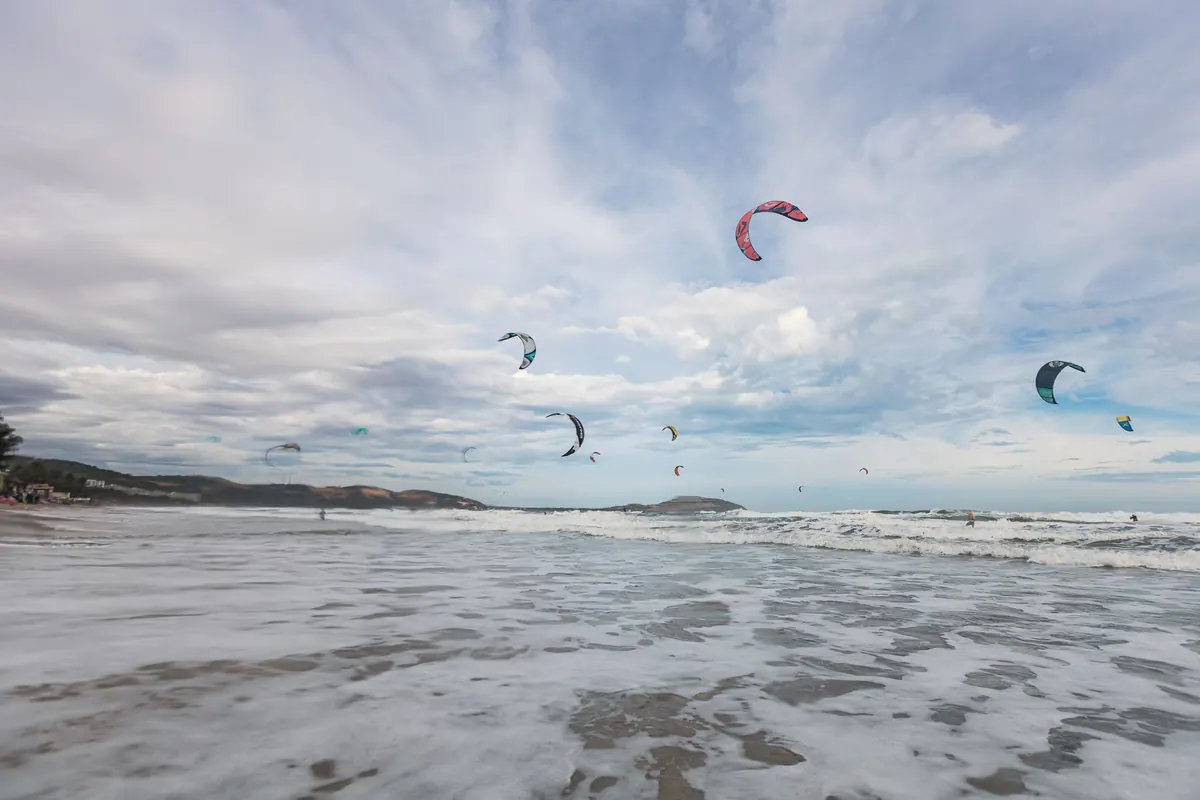
British kite spots rarely serve up the clean, waist-high, side-off perfection you see in edit videos. More often it is 18 to 25 knots, a short chop with a metre of wind swell stacked on top, and a tide that is either racing out or dumping weed across your launch. The board under your feet decides whether that is fun or hard work. Twin-tip or directional? Here is how the two compare in the conditions most UK riders actually get.
Two boards, two very different jobs
A twin-tip is symmetrical: same nose, same tail, ridden in either direction. It is usually 135 to 145cm long, 40 to 44cm wide, with a fairly flat rocker and hard rails. The name says it all — it genuinely does not care which end goes first, which is why it is the default for boosting, rotations and sliding your way through a messy session.
A directional has a distinct nose and tail and is ridden predominantly one way. More rocker, a wider tail, often more volume. You generate speed by trimming along a wave face rather than locking in an edge and pointing upwind. Transitions mean a tack or a jibe instead of a quick slide, and your footwork does far more of the work.
That sounds like a small difference on paper. On the water it changes what you can do with a gust and a lump of swell.
What UK conditions actually throw at you
Chop is the first thing to plan around. A cross-on 22 knots over a shallow, tide-affected beach builds steep, closely spaced chop that throws you off your edge and punishes flat, stiff boards. Then there is wind swell: one to two metres with a short period, often closing out, occasionally reforming into something rideable over a sandbar.
The genuinely clean days — proper lines on Tiree, the north coast of Cornwall, parts of the north-east and west coasts of Scotland — are rare enough that most riders build a quiver around the average session rather than the dream one. Add gusty, shifting wind at inland-influenced spots, plus cold water that makes a long swim distinctly unappealing, and reliability starts to matter more than any spec sheet number.
Twin-tip: the choppy-beach workhorse
If you ride mostly choppy freeride spots with the odd shoulder-high day, a twin-tip is hard to argue with.
- Upwind and speed: simple to hold an edge and get back to the top of the beach.
- Jumping and landings: the whole board is a landing platform. Tail-first crashes stay survivable.
- Transitions: carving turns and sliding transitions take days, not months, to learn.
- Durability and cost: built to take a beating on shingle and rock, and easier to replace.
- One-board simplicity: no quiver debates, no volume maths, no two-board bag on a flight.
The catch is what it cannot do. A twin-tip cannot trim: it has no drive from the wave and no glide to help you connect sections. Push it into real swell and it feels like a plank under your feet. Ride a stiff, flat one at speed through chop and it will rattle your teeth. It is a tool for wind, not for waves.
Directional: when the swell lines up
A directional comes alive when there is a shoulder to work with. The extra area and volume let it plane early, ride over chop instead of into it, and hold a line down the face. Small jumps land softer because the nose lifts and the volume absorbs the impact. You also need less kite, which is a genuine pleasure in gusty conditions.
Strapped, strapless or surfboard-shaped?
Straps make a directional far more forgiving in onshore, messy wind swell — a sensible first step if you are coming from a twin-tip. Strapless feels better and teaches you to read trim properly, but expect a lot more time in the water while you learn. Board-wise, a kite-specific wave board is reinforced under the feet and has more volume, while a standard surfboard will feel looser and lighter but will not survive flat landings for long.
Weaknesses are real too. Upwind progress depends on technique and rail pressure, not brute edge. Jibes take practice and a mis-timed one costs you the wave. They are more fragile, generally more expensive, and not much fun on a flat, brutally gusty inland lake where all you want to do is jump.
Setup and sizing for British beaches
Twin-tip
For an average-weight rider on a 12m kite in 18 to 22 knots, a board around 138 to 142cm long and 42 to 43cm wide with a medium rocker covers most sessions comfortably. Go smaller and stiffer in stronger wind; go wider if you want to plane early and land bigger jumps. Medium fins keep the tail from sliding when the chop gets punchy.
Directional
Think about volume rather than length alone. A wider, slightly longer board lets you drop a kite size and still get going, but too much volume bounces around in short-period chop. It is worth borrowing a couple of different shapes before buying, because the difference between a floaty, forgiving wave board and a low-volume performance shape is enormous on a typical British beach break.
Travel and quiver planning
If you fly with one board, a twin-tip still wins on convenience: it packs flat and survives being wedged into a bag. A directional needs a longer bag and a bit more padding, and airline policies vary, so check the rules before you book. Most riders who commit to waves end up with two boards — a twin-tip for the majority of sessions and a directional for the days worth clearing your diary for. If you want a single compromise, a wider, higher-volume directional with straps is the closest thing to both.
How to decide
Work backwards from your actual sessions, not your aspirations.
- Look at your last ten sessions. Were most of them choppy and gusty? Twin-tip.
- Do you want to jump, spin and ride switch most of the time? Twin-tip.
- Does your local spot get real swell more than a handful of times a year? A directional earns its place.
- Are you willing to spend a season learning to jibe and tack? Without that, a directional will frustrate you.
- Do you travel to wave destinations? Take the directional, or rent one there.
If you are on the fence, borrow or demo a directional for two or three sessions at your regular spot in a decent swell. You will know within an hour whether the trim and glide are worth the learning curve, or whether you would rather be boosting off the back of the chop on a twin-tip. Either answer is fine. The mistake is buying a board for the conditions you wish you had.
Photo: Serg Alesenko / Pexels