


Single-Line vs Dual-Line vs Quad-Line Kites: What's the Difference?
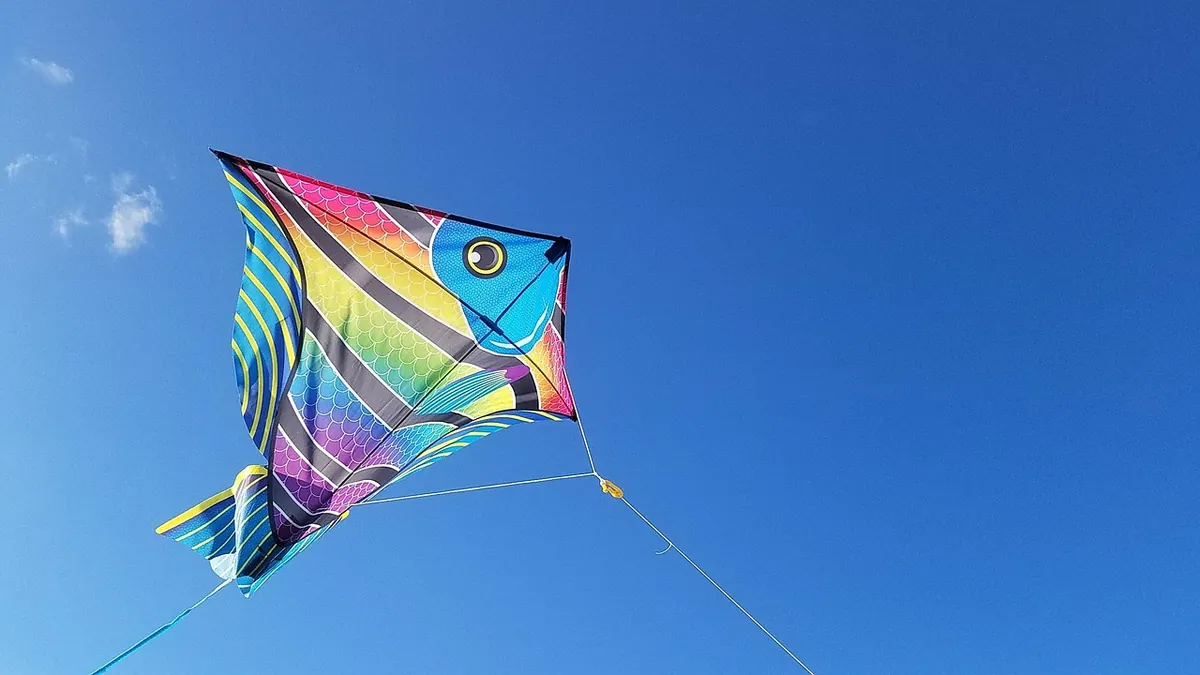
Stand on a breezy beach on a summer Sunday and you will see the whole family of kites in one place: a child's delta tugging at a single string, a stunt kite carving tight figure eights above the breakwater, and a quad-line flier holding their kite dead still in the air as if it were pinned there. They look like variations on the same idea. They behave nothing alike. The number of lines you hold decides what the kite can do, how the wind arrives in your hands, and how long it takes before you stop crashing and start flying.
Single-line kites: along for the ride
Single-line kites do one job and do it well: they go up, they stay up, and they look good on the end of a taut line. Diamond kites, deltas, sleds, box kites, soft parafoils and the huge character kites at festivals all belong here.
There is no steering. You choose a launch spot, let out line, and the kite drifts where the wind and its own design take it. You can nudge things along — walk upwind to add apparent wind, adjust the bridle, clip on a longer tail for stability — but you will never turn it left or right. Control amounts to how much line you let out and when you reel it back in.
The wind range is the kindest of the three. A delta or parafoil will fly in a light coastal breeze and keep going as it builds, box kites shrug off gusty conditions, and the big soft kites fly in almost nothing at all. Skill requirement: minimal. Give a patient adult, a small delta and a clear stretch of beach, and a five-year-old will be flying within minutes.
Best uses: family afternoons, first flights, festival displays, line laundry, and lifting a camera on a stable platform.
Dual-line kites: where you start steering
Two lines, one in each hand, and suddenly the kite answers to you. Pull your right hand and the kite turns right. Pull both hands back and it accelerates across the window; push both forward and it loses drive. That is the entire grammar of dual-line flying, and it is enough for loops, figure eights, sharp corners and your first taste of precision.
The catch is that a dual-line kite only goes forwards. There is no reverse gear. To slow down or stop, you fly it to the edge of the wind window, where the air is thin and the kite loses power. Everything you learn is about managing that: keeping the kite moving, using the edges deliberately, and not fighting it in the middle where the pull is strongest.
Wind range depends heavily on the model. Broadly, most sport kites are comfortable in a steady breeze of roughly 5 to 20 mph, with lighter, larger kites suiting the lower end and smaller, heavier ones built for the top. Smooth coastal wind is far easier to fly in than the choppy, shifting air you get inland.
Skill: the first hour is humbling. You will over-correct and you will crash. That is normal, and the second session is usually where it clicks. Best uses: recreational stunt flying, precision practice, and pair or team routines flown to music.
Quad-line kites: four lines, complete control
Quad-line kites use two handles and four lines — two to each handle. The extra pair gives you brakes and, with them, reverse. A quad-line kite can stop dead in the air, fly backwards, spin on the spot, track sideways across the window and hold a hover for as long as your arms last.
The control is the most complete of the three, and the most confusing at first. Rotating a handle changes the angle of the wing, so the inputs are less about pulling left and right and more about balancing power across four points. Beginners often find the first twenty minutes bewildering.
Then the advantage appears: because you can brake, you can also stop. Heading for the ground, you back the kite out of trouble instead of watching it hit. The learning curve is steep, but rarely punishing.
Wind range is the widest of the three, precisely because braking lets you spill power in strong wind and keep the kite flying in very little. Some quad-line kites are flown indoors, in still air, on short lines.
Don't confuse them with four-line power kites
Four-line traction kites used for kite buggying, landboarding and kitesurfing also have four lines, but they are a different animal: built to generate pull, flown on a bar or handles with brake lines to depower, and not intended for the hovering, reversing precision flying described above. Same line count, different sport.
The three types side by side
- Single-line — one line, no steering, flies in light to moderate wind, almost no skill needed. Best for relaxed family flying, festivals and line laundry.
- Dual-line — two lines, full steering and loops but no reverse, roughly 5 to 20 mph depending on the model, a moderate learning curve. Best for recreational stunt flying and team displays.
- Quad-line — four lines, steering plus reverse, hover and sideways flight, the widest usable wind range and the steepest start. Best for precision routines, indoor flying and team work.
Wind range, space and line length
Kite size matters as much as line count. A bigger kite in light wind behaves like a smaller kite in a strong one, so ranges overlap constantly. The honest answer to "will this fly today?" comes from the manufacturer's stated wind range, read cautiously — and from an honest look at the gusts.
Line length varies by type. Single-line kites are often flown on 30 to 100 metres; dual-line and quad-line kites usually sit around 20 to 25 metres, where you can still see the kite clearly and react quickly.
Space is the other variable. Dual-line and quad-line kites need a clear area roughly the size of a tennis court, with nobody downwind, because that is exactly where the kite goes when it all goes wrong. Check for overhead power lines, roads, airports and nesting birds before you unpack anything. If the wind makes you nervous, it is strong enough to leave the kite in the bag.
Where to start
If you want a kite for a sunny afternoon with no ambition
Photo: danielmills / Pixabay