


10 Common Kiteboarding Mistakes Beginners Make (and How to Fix Them)
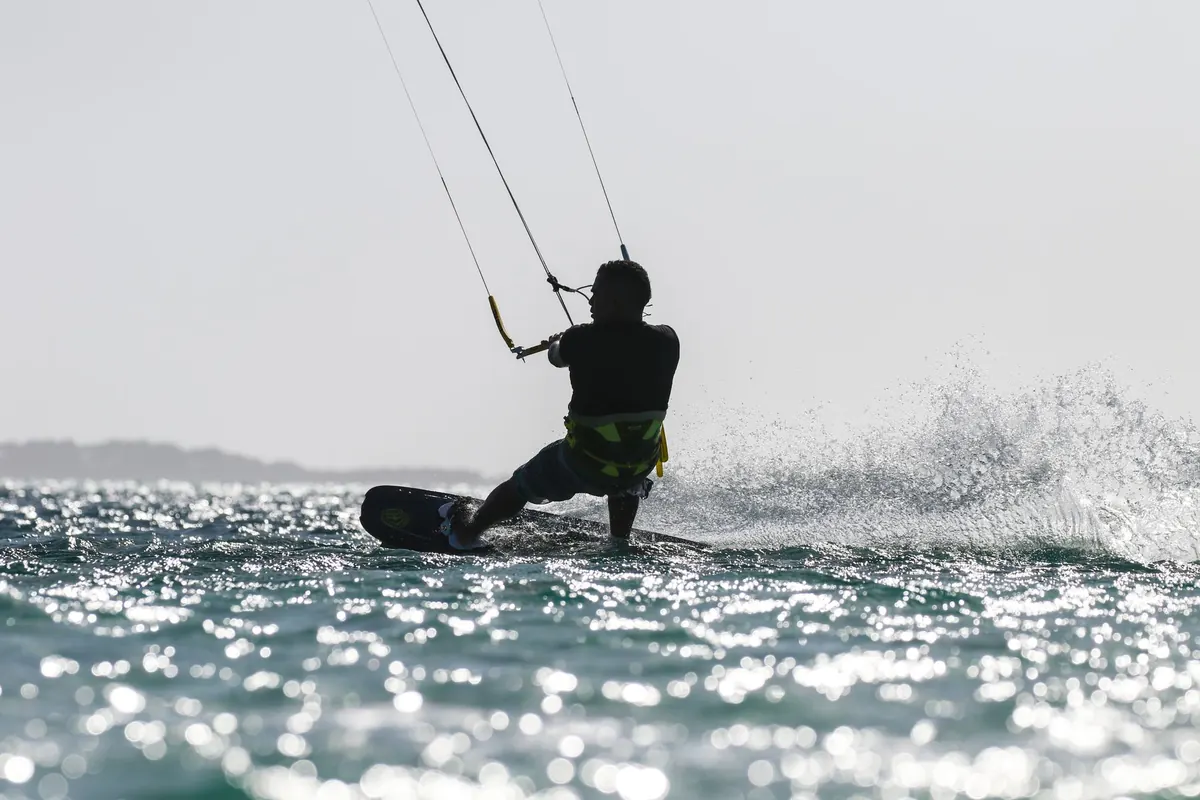
Most kiteboarding problems start before the kite even hits the water. They begin as small habits: a kite parked in the wrong place, a rail dug in a fraction too soon, a hand gripping the bar far too hard. Change the habit and the crash usually disappears with it. Almost every beginner error has a straightforward correction, and most of them can be practised deliberately on your next session.
1. Parking the kite in the wrong part of the window
Two versions of the same mistake: sending the kite straight to 12 o'clock and standing under it like an umbrella, or pushing it so far towards the edge that it stalls and drops. The first delivers a sudden yank the moment the kite drifts; the second gives you no power at all.
Think of the wind window as a clock face. For most riding you want the kite sitting around 10 or 11 o'clock, or 1 to 2 o'clock on the other tack — high enough to stay clear of the water, low enough to pull steadily. Power arrives when you fly the kite through the middle of the window; calm returns when you send it back to the edge.
- Body drag across the window until steering feels automatic without looking at the kite.
- Practise slow figure-eights, keeping the kite's movement smooth and small — under a metre.
- Use the middle of the window to power up and the edge to slow down, and rehearse both before you need them.
2. Edging too early
The moment the board starts moving, the instinct is to lean back and dig the rail as hard as possible. The rail bites, the board stalls, the kite keeps pulling, and you get launched over the front.
Edging works when there is speed to convert into grip. Ride slightly downwind first, build board speed, then edge progressively — a little more each second, feeling the pressure build through your heels. If the board slows or the kite starts to stall, ease the edge off rather than hauling harder on the bar.
A useful cue: point your leading shoulder where you want to go and keep your hips over the board. If your back leg is doing all the work, you are not edging, you are dragging.
3. Ignoring the safety releases
Nobody plans to use the quick release, which is exactly why it pays to know it cold. Under load, in cold water, with the kite diving, you have about a second to react. Fumbling for the wrong strap is not a skill worth learning mid-emergency.
A pre-session routine takes two minutes:
- Find your quick release and pull it while wearing gloves, before you get in the water.
- Check that your kite leash is attached to the designated point on your harness, not to a flying line.
- Untangle your lines, check the bar is the right way round, and confirm your left and right lines match the kite.
- Agree launch and landing signals with a buddy, and never launch alone.
- Rehearse a self-rescue in waist-deep water with an instructor until it feels boring.
If you are being dragged, let go of the bar first — it is the quickest way to kill the pull — then reach for the release. Learn through a recognised training scheme and ask your instructor about the specific safety setup on your own kit. If you have an injury or a medical condition, get proper advice from a professional before pushing hard.
4. Steering with your arms
Your arms are for fine-tuning. Your harness and body weight do the heavy lifting. Beginners pull hard with their arms, grip somewhere near the centre of the bar, and sheet in with bent elbows. Twenty minutes later they are exhausted and the kite is still reacting late.
Keep your hands shoulder-width apart near the bar ends or just inside the floats, elbows relaxed, and let the harness take the load. A kite turns in proportion to how far the bar moves, not how hard you pull it. Small, slow movements, one hand when the kite is stable, and the bar kept in front of you rather than hauled down to your chest.
If your forearms are burning, you are probably holding more power than you need. Pull on some depower trim and check whether your kite is simply too big for the conditions.
5. Flying a kite that's too big
There is a temptation to ride the biggest kite you can keep in the air, because it feels like progress. In practice, an overpowered beginner spends the whole session hanging on, with no spare attention to steer, edge, or look where they are going.
Choose a kite that leaves you comfortably powered: enough to get up and stay upwind, not so much that you are fighting it. You should be able to fly it one-handed for a few seconds, control your speed with the board, and let go of the bar without panicking. If you cannot edge without the board skipping, or every gust pulls you off your line, come in and rig smaller.
6. Watching the kite, or worse, your feet
Beginners stare at the kite for comfort and at the board for reassurance. Both keep the head down and the body twisted, which makes riding in a straight line difficult and going upwind feel impossible.
Look where you want to go. Pick a fixed point on shore — a building, a tree, a moored boat — and ride towards it. Glance at the kite only when you are correcting it, then bring your eyes back to the horizon. Your board follows your chest, and your chest follows your eyes.
7. Skipping the drills that make everything easier
The riders who progress fastest are usually the ones willing to spend a session on the boring stuff: body dragging upwind to retrieve a lost board, flying one-handed, relaunching after a crash, performing a self-rescue.
Add one drill to the start of every session. Ten minutes of kite control before you pick up the board will save you hours of swimming later. Work in waist-deep water where you can stand, and do not move on until the drill feels automatic.
Turning the Fixes Into a Plan
Pick two mistakes from this list — no more — and make them your focus for the next session. A simple structure works well: warm up with ten minutes of kite control and body dragging, set one board goal such as riding twenty metres downwind before edging, then finish with a safety drill even if the session went well.
Keep one question running in your head as you ride: is the kite flying where I want it, and am I letting the board carry my weight? Get those two right, and most of the rest sorts itself out.
Photo: Harold Granados / Pexels